Introduction
The CPU (Central Processing Unit) is the main execution core of a computer system. It fetches, decodes, and executes instructions sequentially.
Internally, the CPU consists of multiple operational units working together to process instructions, manipulate data, and control overall system operation.
Understanding CPU organization helps programmers write optimized code and debug low-level processor behavior.
Major Components of a CPU
A processor mainly consists of:
- •Control Unit (CU)
- •Arithmetic Logic Unit (ALU)
- •Registers
- •Instruction Decoder
- •Internal Bus Path
These components share data and control signals during instruction execution.
Control Unit (CU)
The Control Unit manages and coordinates all operations inside the processor.
Its primary responsibilities include:
- •Fetching instructions
- •Decoding instructions
- •Generating control signals
- •Directing data flow between units
- •Controlling memory access
Instruction → Control Unit → Control Signals → ALU / Registers / Memory
Arithmetic Logic Unit (ALU)
The ALU performs all arithmetic and logical operations inside the processor.
Common ALU operations include:
- •Addition
- •Subtraction
- •Multiplication
- •Division
- •Logical AND, OR, XOR
- •Bitwise shifting
- •Comparisons
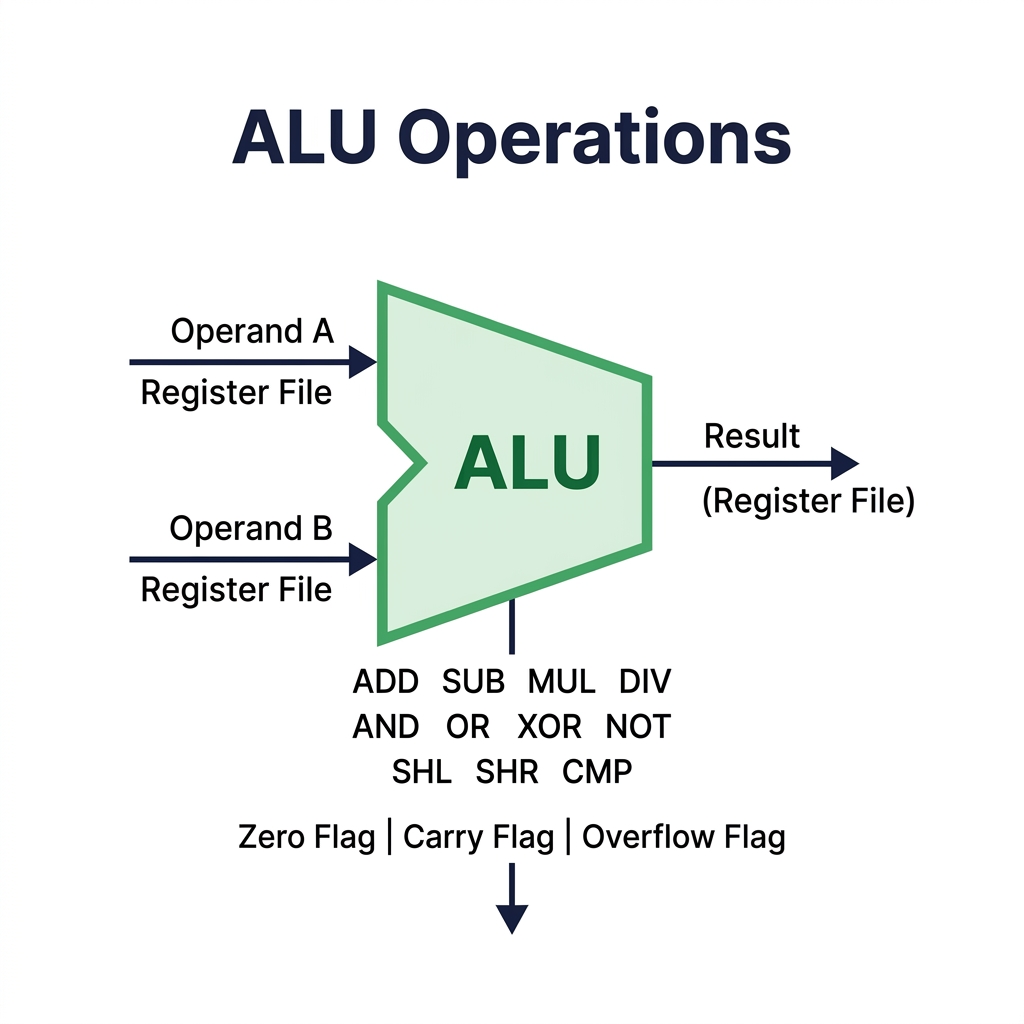
The ALU is considered the computational engine of the CPU.
Registers
Registers are ultra-fast storage locations located inside the processor.
They are generally used to:
- •Store active data
- •Hold memory addresses
- •Store intermediate results
- •Store processor status flags
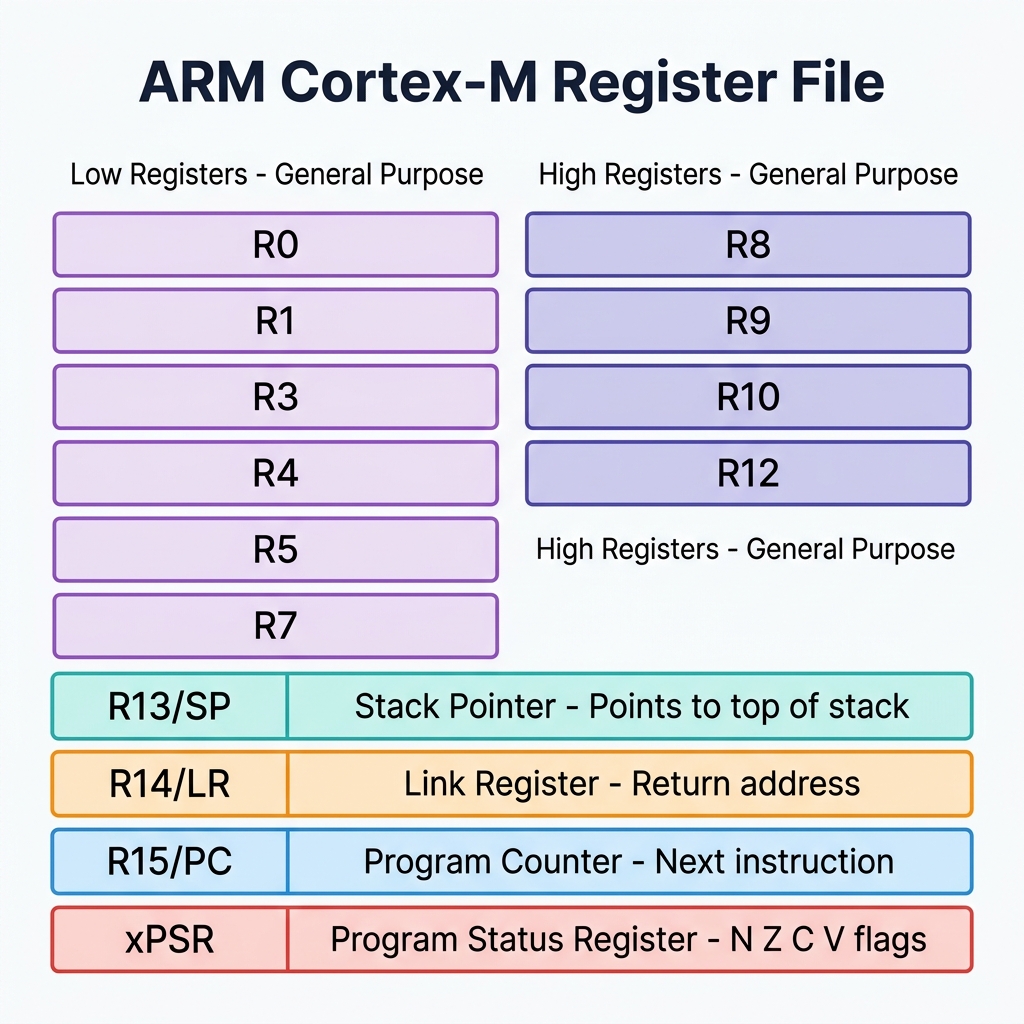
Most processors contain specific types of registers, each serving a distinct hardware function:
| Register | Function |
|---|---|
| Program Counter (PC) | Stores address of next instruction |
| Instruction Register (IR) | Holds current instruction |
| Stack Pointer (SP) | Points to stack memory |
| General Purpose Registers | Temporary data storage |
Program Counter (PC)
The Program Counter contains the memory address of the next instruction to be executed. As the processor executes instructions, the PC automatically increments.
When a function call or branch operation occurs, the processor updates the PC with a new target address. Forgetting to save the return address causes a PC corruption.
Instruction Register (IR)
The Instruction Register holds the currently fetched instruction from memory.
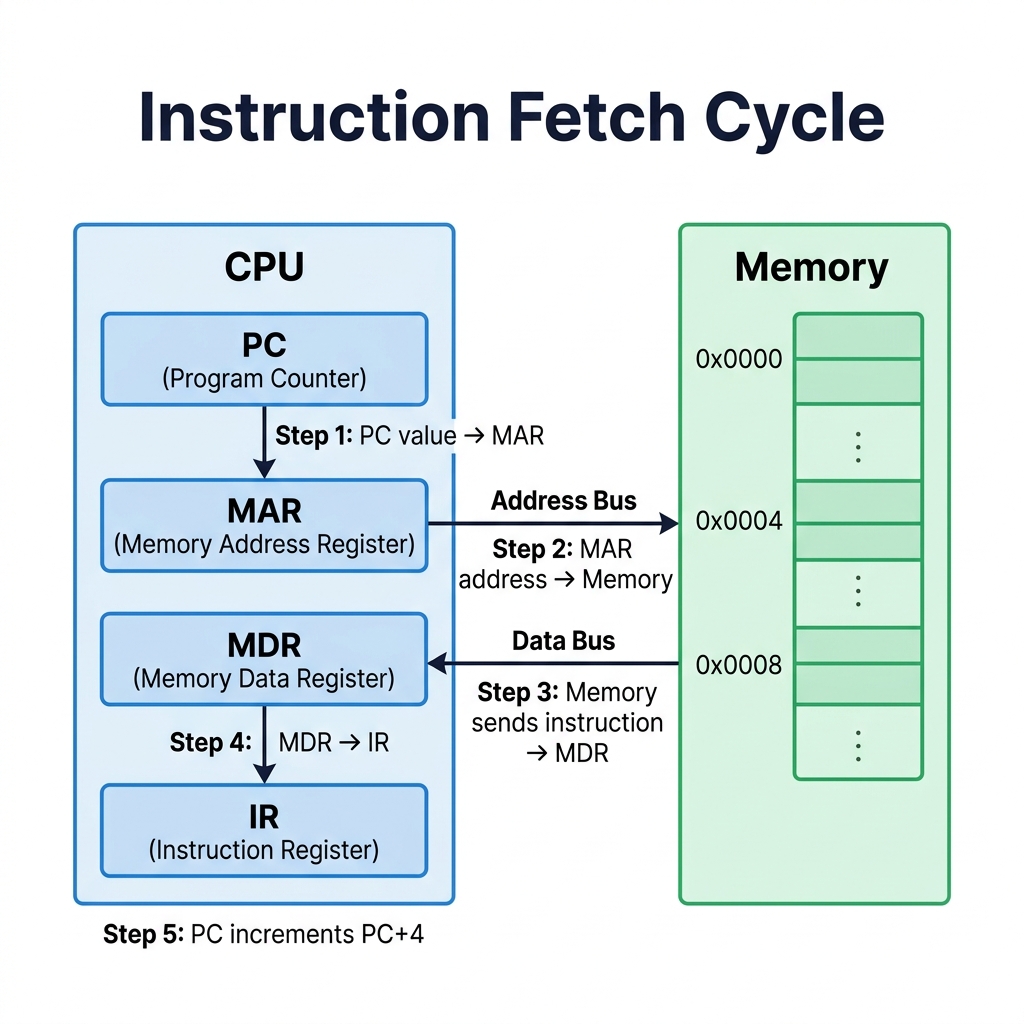
The Control Unit decodes the instruction stored inside the IR.
Stack Pointer (SP)
The Stack Pointer tracks the current location of the stack memory.
The stack memory is used for:
- •Function calls
- •Local variables
- •Return addresses
- •Temporary storage
Stack Memory → Stack Pointer (SP)
The SP automatically adjusts as data is pushed or popped from the stack.
CPU Data Flow
During execution, instructions and data continuously move between memory, registers, and the ALU.
Memory → Fetch Instruction → Registers → ALU Processing → Result Storage
This continuous movement forms the core foundation of architecture operations.
CPU Clock
The CPU Clock provides a continuous timing signal that synchronizes internal operations. Processor speed is usually measured in Hertz (Hz), which represents clock cycles per second.
Clock Signal → Synchronizes CPU Operations
Common embedded clock speeds:
- •16 MHz (Microcontrollers)
- •1 GHz (System-on-Chips)
Higher clock speeds generally allow a processor to execute more instructions per second.
Instruction Processing Example
If a program asks the CPU to add two numbers (e.g., z = x + y), the processor internally will perform:
- Fetch the ADD instruction from memory
- Decode the ADD operation
- Load x and y into internal registers
- Pass x and y into the ALU
- Store the ALU result (z) back into memory
💡 Important Points
- →The CPU is the execution engine of the computer
- →The Control Unit manages execution flow
- →The ALU performs arithmetic and logical operations
- →Registers provide ultra-fast temporary storage
- →The Program Counter tracks the next instruction to execute
- →The Stack Pointer manages stack operations
- →All components work together to coordinate internal hardware operations
🚀 Embedded Systems Perspective
In embedded systems, firmware code directly interacts with CPU components. Understanding how registers store data, how the Program Counter controls execution flow, and how the stack manages function calls is critical for firmware development.
This knowledge becomes especially important when handling hardware interrupts, optimizing memory usage, and performing low-level driver development.
🔹 Next Chapter
In the next chapter, we will explore the internal execution flow of processor instructions.
- •Instruction pipeline
- •Fetch, decode, execute
- •Instruction latency
- •Branch execution
- •Processor clock timing